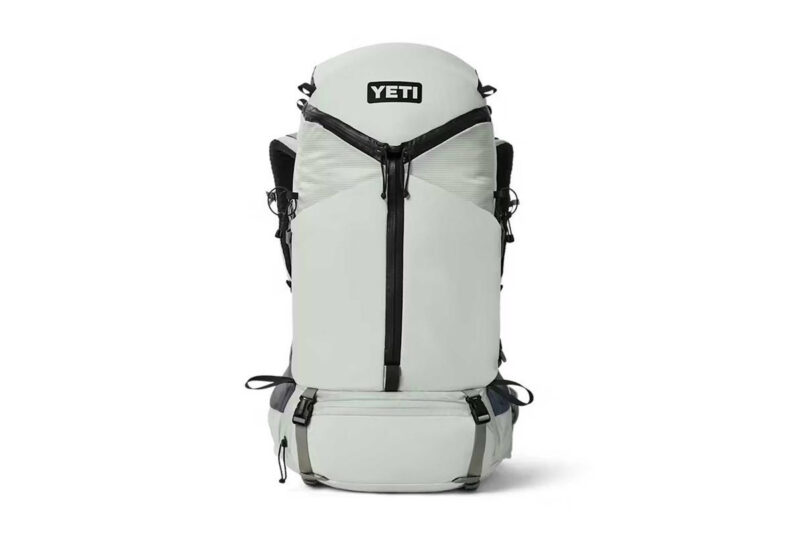
So the cooler company made a backpack.
I know, I know. When I first heard YETI was getting into hiking packs, my reaction was probably the same as yours: “Great, another overpriced lifestyle brand slapping its logo on generic outdoor gear.” YETI makes incredible coolers and drinkware. Nobody’s arguing that. But backpacks are a completely different animal, and the trail doesn’t care about your brand loyalty.
Then I looked at the spec sheet. And then I remembered that YETI quietly acquired Mystery Ranch in 2024. And then I looked at the spec sheet again.
Okay. Let’s talk about this.
What’s Actually in the Box
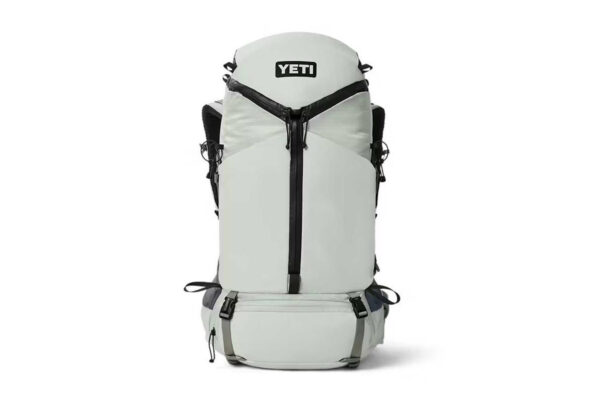
The YETI Skala launched this month in four sizes: 32L, 40L, 50L, and 60L, with both men’s and women’s specific fits. That’s not a token lineup. That’s a company saying “we’re serious about this category.” Here’s the quick rundown:
32L ($300) – Day hikes, summit pushes, carry-on friendly. 3.3 lbs.
40L ($325) – Longer day hikes, overnighters. 3.4 lbs.
50L ($375) – Multi-day trips, weekenders. 4.5 lbs. Includes sleeping bag compartment.
60L ($400) – Extended trips, thru-hike territory. Includes sleeping bag compartment.
Four colorways at launch: Ridgeline (a greyish white) and Classic Navy as permanent options, with Venom (green) and Desert Bloom (pink) as seasonal drops.
The Mystery Ranch Connection (This Is the Important Part)
Here’s what separates the Skala from “cooler brand makes backpack.” When YETI acquired Mystery Ranch, they didn’t just buy the name. They got decades of technical pack design expertise from a company that built its reputation outfitting wildland firefighters and military personnel. The guy who founded Mystery Ranch, Dana Gleason, literally designed packs for people whose lives depended on load carriage working flawlessly.
That DNA shows up in the Skala in a few key ways.
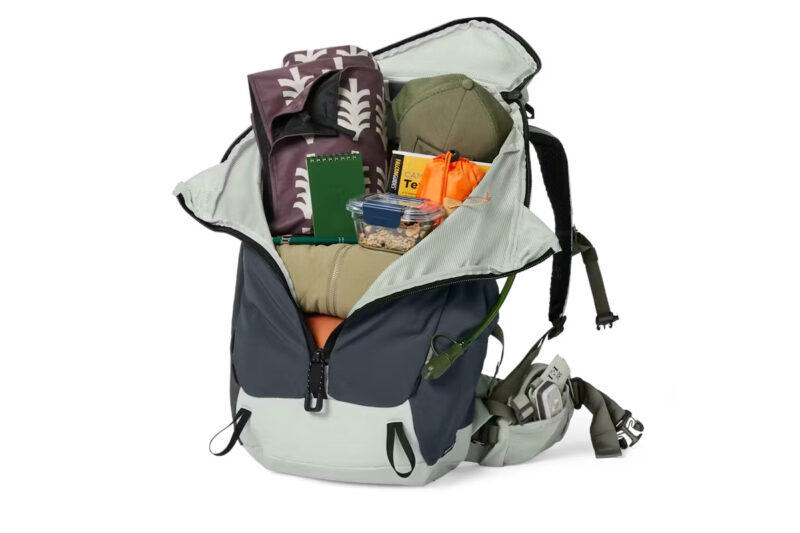
The RipZip opening is the headliner. It’s a Y-shaped, three-way zipper system that Gleason originally designed for ski touring, where fumbling with a top-loading pack while wearing gloves is a recipe for frustration. You pull it open and get a panoramic view of everything inside your pack without having to excavate from the top down. Mystery Ranch has used this design in their most iconic military and outdoor packs for years. If you’ve ever dug through a top-loader looking for your rain jacket while it’s already pouring, you understand why this matters.
The AlumaLite aluminum frame is the other big inheritance. It distributes weight to your hips and shoulders without adding significant pack weight, and it’s a system Mystery Ranch has been refining through countless iterations of load-bearing packs. The micro-adjustable harness offers eight inches of torso adjustment, which is a solid range.
YETI also brought in Layne Rigney, the former CEO of Osprey, to run their carry division. So you’ve got Mystery Ranch engineering plus leadership from one of the most respected names in the pack world. On paper, this is a serious pedigree.
YETI is trying to relevant in the backpack world, but I don’t know why other than to be able to say “See, we are cool too.”
What I Actually Like
The weight. The 40L at 3.4 lbs is genuinely competitive. The 50L at 4.5 lbs sits right in line with the Osprey Atmos AG 50 (4.3 lbs) and well under the Gregory Baltoro 65 (4.7-5.2 lbs), though those are different capacity comparisons. The point is, YETI didn’t build a tank. Guardcore Nylon keeps things light while still being weather-resistant and abrasion-tough.
The women’s fit is actually designed for women. This isn’t a shrink-it-and-pink-it situation. YETI says they did specific research and fit studies to redesign the shoulder harness curvature, arc, and length for women’s torsos. The waistbelt comes in two sizes. As someone who’s worn too many “women’s” packs that were clearly just downsized men’s models, I appreciate this.
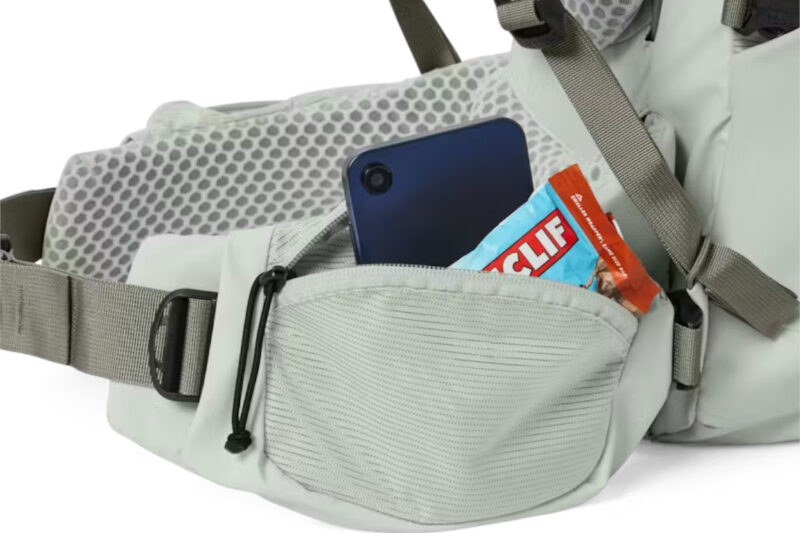
The organization. Multiple internal and external pockets, stretch-woven hydration holsters that sit tight against the pack body so they don’t swing, and the 50L/60L models get that externally accessed sleeping bag compartment at the bottom. YETI describes their approach as a “cooler mindset” for organization, which sounds like marketing speak until you realize that their cooler design philosophy is literally about keeping everything in its place and protected. Fair enough.
The vented back panel. If you’ve ever used YETI’s old Panga bags for hiking (don’t), you know “sweaty back” was putting it politely. The Skala’s mesh back panel with urethane foam actually addresses this.
What I’m Critical Of
The overall design language is safe. Look, I get it. This is YETI’s first serious hiking pack and they’re playing it smart by leaning on proven Mystery Ranch engineering rather than trying to reinvent the wheel. But the Skala doesn’t really push any boundaries. The RipZip is the most innovative feature, and that’s been around in the Mystery Ranch ecosystem for years. Everything else is competent execution of existing backpack design principles. There’s nothing here that makes me say “nobody else is doing that.”
The weight, while competitive, isn’t groundbreaking. Multiple reviews have praised the Skala for being “lightweight,” and sure, compared to YETI’s reputation for overbuilt, heavy-as-a-brick products, it is. But in the actual backpacking world? An Osprey Exos 58 comes in at 2.9 lbs. An REI Flash 55 is 2.7 lbs. The Gregory Focal 58 sits at around 2.6 lbs. If you’re an ultralight backpacker trying to hit that vanity sub-10-pound base weight, saving even half an ounce matters, and the Skala isn’t in that conversation. OVR Magazine noted this same tension. The Skala is light for a fully featured pack, but it’s not a lightweight pack.
No included rain cover. This is one I know will bug some people, and honestly? I don’t care that much. If you’re backpacking in truly wet weather, you should be using a pack liner anyway. A rain cover flapping around in wind is more annoying than useful, and it doesn’t protect the back panel or bottom of your pack where water actually pools. A simple trash compactor bag or a proper pack liner from Sea to Summit keeps everything inside your pack dry regardless of where the water hits. That said, at $300-$400, it would be a nice inclusion, especially since the Osprey Atmos includes one and the Gregory Baltoro used to.
The price. Let’s address this directly. Here’s how the Skala stacks up against the competition in the multi-day category:
| Pack | Capacity | Weight | Price | Rain Cover | Warranty |
|---|---|---|---|---|---|
| YETI Skala | 50L | 4.5 lbs | $375 | No | 3-year |
| Osprey Atmos AG 50 | 50L | 4.3 lbs | $350 | Yes | Lifetime |
| Osprey Atmos AG LT 50 | 50L | ~4.1 lbs | $290 | Yes | Lifetime |
| Gregory Baltoro 65 | 65L | 4.7-5.2 lbs | $370 | No | Lifetime |
| Osprey Exos 58 | 58L | 2.9 lbs | $285 | No | Lifetime |
| REI Flash 55 | 55L | 2.7 lbs | $219 | No | Lifetime |
That $375 for the 50L puts the Skala at a premium over some incredibly well-established packs, several of which offer lifetime warranties versus YETI’s 3-year guarantee. Osprey’s All Mighty Guarantee is legendary for a reason. If your Atmos breaks in year five, they fix or replace it. With YETI, you’re on your own after year three.
That’s a meaningful gap when you’re trusting your pack 15 miles from the nearest trailhead.
Who Is This Pack Actually For?
The Skala isn’t trying to be everything to everyone, and that’s fine. Here’s who I think should actually be looking at this:
YETI loyalists who are getting into backpacking. If you already own YETI everything and you want your pack to match the ecosystem, the Skala is a genuinely good pack. It’s not a vanity purchase. It’ll perform well on the trail.
People who prioritize gear access over weight savings. The RipZip opening is a real advantage if you’re constantly digging into your pack throughout the day. Top-loading purists won’t care, but if you’ve ever wanted panel-loading convenience on a trail pack, this delivers.
Backpackers in the 50-60L range who want a durable, comfortable carry. The AlumaLite frame and Mystery Ranch suspension system are proven. If your typical load runs 30-40 lbs, the Skala will handle it.
Who should skip it: Ultralight backpackers, budget-conscious hikers, and anyone who considers warranty length a major purchase factor.
The Bottom Line
The YETI Skala is a good first effort from a company that clearly took this category seriously. They didn’t just slap a YETI logo on a generic pack and call it a day. They acquired one of the most respected pack companies in the world, hired leadership from another, and built something that genuinely competes with established players.
But “competes with” isn’t “beats.” At this price point, with a 3-year warranty versus lifetime options from Osprey and Gregory, you need to be honest about what you’re paying for. Some of that premium is YETI brand equity, and there’s nothing wrong with that if the pack fits you well and meets your needs. But the trail doesn’t read logos.
I’d love to get my hands on the 50L for a proper field test in the Cascades this spring. Until then, my take is this: try it on in a store, load it up, and see how the RipZip works for you. If it clicks, you’ll be happy with it. If you’re on the fence, an Osprey Atmos at $350 with a lifetime warranty is a really hard value to beat.
What do you think? Is YETI’s backpack play going to shake up the market, or is this just another premium brand testing the waters? Drop your thoughts in the comments, or shoot us an email at cliff@10toestravel.com. I’m especially curious to hear from anyone who’s already gotten their hands on one.
Sierra is a backcountry enthusiast and gear nerd who’s logged more miles than she’d like to admit on Pacific Northwest trails. When she’s not testing backpacks, she’s probably arguing about tent footprints on Reddit.
Source: Product details referenced from YETI, Gear Patrol, and OVR Magazine. This is not a sponsored post. 10ToesTravel has not received any product from YETI for this article.