Portable power stations have quietly become one of the most useful pieces of car camping gear you can own — no generator noise, no fumes, no extension cord running to a hookup site. Just charge it at home, toss it in the car, and you’ve got a silent power source that handles phones, lights, laptops, small fridges, and a whole lot more.
The catch? The market is flooded with options ranging from genuinely excellent to glorified phone chargers with a marketing budget. Buy the wrong one and you’ll either run out of juice halfway through day two or spend three hundred dollars more than you needed to.
This guide cuts through it. We’ll cover what size you actually need for your trip type, which brands are worth trusting, and a few specific use cases — including one that affects more campers than most gear sites bother to address.
No fluff. Just watts, real prices, and straight talk about what’s worth your money.
What Is a Portable Power Station (And Why Not Just Bring a Generator)?
A portable power station is a big rechargeable battery with outlets built in — AC outlets, USB ports, DC ports. You charge it at home, you take it camping, you plug things into it like a quiet, fume-free, indoor-legal power source.
The comparison to a gas generator is worth making directly, because a lot of people still default to generators for car camping. Here’s why I’ve moved past that:
Gas generators are loud. Like, genuinely obnoxious. If you’ve ever been the campsite neighbors of someone running a generator at 10 PM, you know exactly what I’m talking about. Portable power stations run silent. Dead quiet.
They also don’t produce carbon monoxide, which means you can use them inside a tent, a truck cab, or a camper without worrying about killing yourself in your sleep. Generators cannot be used indoors. At all. Ever.
And for most car camping use cases — phones, lights, a fan, maybe a small fridge — a good power station has more than enough juice to get the job done.
The tradeoff is they have a fixed capacity. When the battery’s gone, it’s gone until you recharge it. A generator just needs more gas. That’s a real difference for extended off-grid trips, which is why solar compatibility matters. More on that below.
The Number That Actually Matters: Watt-Hours (Wh)
Before we look at specific units, you need to understand one number: watt-hours, or Wh. This is the actual measure of how much energy a power station stores. Everything else — the number of ports, the display, the color — is secondary.
Here’s a simple way to think about it: if a device uses 10 watts and you run it for 10 hours, that’s 100 watt-hours used.
Real-world planning is pretty simple once you know your devices’ wattage (usually printed on the device or in the manual):
- Smartphone charge: roughly 15-20Wh per full charge
- Laptop: 50-100Wh per full charge depending on size
- LED camp lantern: 5-15Wh per night
- Portable 12V fridge/cooler: 40-60Wh per hour (this is the big one)
- Small fan: 10-30Wh per hour
One thing worth knowing: the usable capacity of a power station is always somewhat less than the rated capacity. Real-world testing consistently shows you’ll get somewhere between 85-93% of the stated watt-hours. Build that into your planning, and add a 20% buffer on top of your estimate.
How Much Capacity Do You Actually Need?
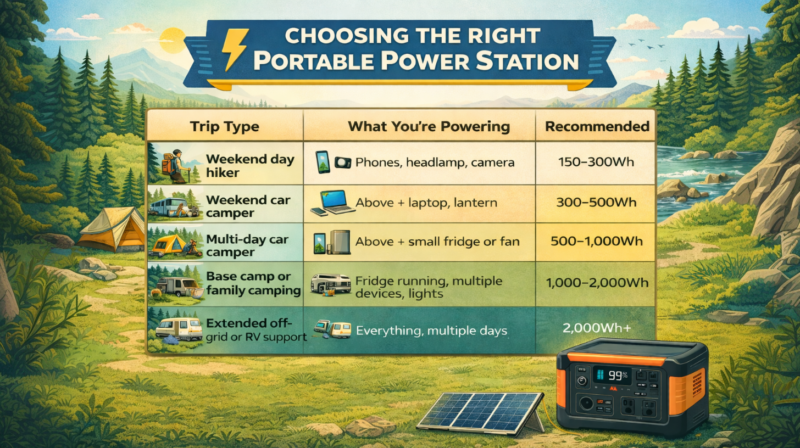
Here’s a quick cheat sheet before we get into specific models:
| Trip Type | What You’re Powering | Recommended Capacity |
|---|---|---|
| Weekend day hiker | Phones, headlamp, camera | 150-300Wh |
| Weekend car camper | Above + laptop, lantern | 300-500Wh |
| Multi-day car camper | Above + small fridge or fan | 500-1,000Wh |
| Base camp or family camping | Fridge running, multiple devices, lights | 1,000-2,000Wh |
| Extended off-grid or RV support | Everything, multiple days | 2,000Wh+ |
If you’re running a small fridge, jump straight to the 500Wh+ section — that’s where the math changes.
Battery Chemistry: LiFePO4 vs. Li-ion (The Short Version)
You’ll see two battery types in portable power stations right now. Here’s what the difference means for you practically:
Lithium-ion (Li-ion/NMC): Older, more common in budget units. Typically rated for 500-800 charge cycles. Cheaper to manufacture. Loses capacity faster over time, especially in cold weather.
LiFePO4 (Lithium Iron Phosphate): Newer chemistry, increasingly standard in mid-range and premium units. Rated for 3,000-4,000+ cycles. Significantly better cold weather performance. More stable chemistry. Costs a bit more up front but lasts dramatically longer.
If you’re camping in the Pacific Northwest — which means shoulder-season temps, wet conditions, cold mornings — LiFePO4 is worth the slight price premium. If you’re camping twice a year on your cousin’s property in July, the cheaper Li-ion unit will probably serve you fine.
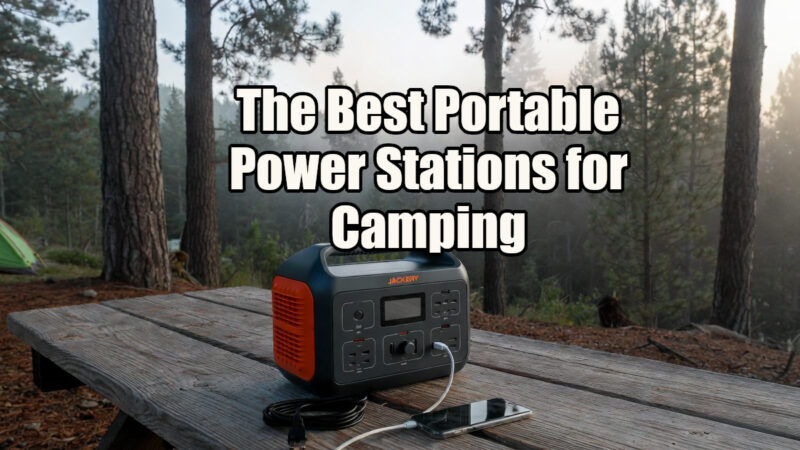
The Best Portable Power Stations for Camping
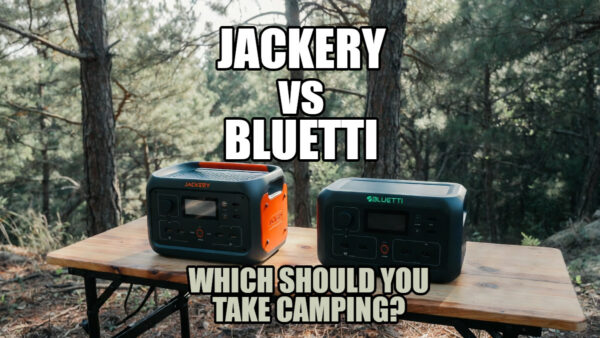
Two brands anchor this guide: Jackery and Bluetti. Both have strong real-world track records and compete well against each other at every price point. I’ll break them down side by side at each capacity tier so you can pick the one that fits your priorities.
Under 300Wh: Light Weekend Power
Who it’s for: Solo campers, weekend day trips, people who just want phones, a lantern, and a camera charged without overthinking it.
The Jackery Explorer 300 Plus at $269 is a solid pick at this tier. At 288Wh with LiFePO4 chemistry, 4,000+ cycle lifespan, and 8.3 pounds, it’s genuinely grab-and-go. Handles two or three nights of basic device charging without issue.
Bluetti’s entry here is the AC2A at $219. It’s 204Wh with 300W output, 600W Power Lifting mode, LiFePO4 rated for 3,000+ cycles, and just 7.9 pounds — actually slightly lighter than the Jackery. Charges 0-80% in 45 minutes and comes with a 5-year warranty. At $60 less than the 300 Plus it’s worth a look if budget is the priority. Worth verifying availability before buying as Bluetti has been known to cycle this one in and out of the active lineup.
Both units handle the same basic use case well — phones, lights, camera batteries for a weekend. Neither will run a fridge for any meaningful stretch or power anything with a heating element. Know those limits going in and neither will disappoint you.
500–800Wh: More Power, Still Portable
Who it’s for: Campers who want a full weekend of real-world power — fridge running, multiple devices charging, no rationing — without stepping up to a 20+ pound unit.
The Jackery Explorer 600 v2 is the pick here from the Jackery side. At 640Wh with LiFePO4 chemistry rated for 6,000+ cycles, 500W output, and just 14.11 lbs, it’s one of the lightest units in its capacity class. Charges to full in about 70 minutes via hybrid AC charging. It’s a clean step up from the Explorer 500 with better battery longevity and meaningfully more capacity.
Bluetti counters with the AC70 at around $599 — 768Wh, 1,000W output with 2,000W Power Lifting mode, LiFePO4 with 3,000+ cycles, and 22.5 lbs. More capacity and more output than the 600 v2, at the cost of extra weight. It also accepts up to 500W of solar input, which is exceptional for this price range. The AC70 frequently goes on sale well below its list price. Worth checking availability — it also runs in and out of stock on Bluetti’s site.
Honest take: the 600 v2 wins on weight and battery longevity. The AC70 wins on capacity, output headroom, and solar input ceiling. If you’re running a fridge all weekend and want headroom to spare, the AC70’s extra capacity earns its extra weight.
1,000–2,000Wh: Best Overall for Most Campers
Who it’s for: Campers who want to stop thinking about power entirely. Family camping, base camp setups, small fridge runners, multi-day trips.
Three strong units live in this tier.
The Jackery Explorer 1000 v2 at around $999 is one of the most well-reviewed units in this category. At 1,070Wh with LiFePO4 chemistry, 1,500W output, and a 1-hour fast charge, it covers almost everything a car camper would realistically need for a long weekend. Easiest unit in its class to just pick up and use.
The Bluetti Elite 100 V2 at around $799 is 1,800Wh with automotive-grade LiFePO4 cells rated for 6,000+ cycles — the longest-rated battery in this tier — and 1,024W output with 3,600W surge via Power Lifting. About 35% more compact than competing 1,000Wh units, which matters if trunk space is tight.
The Bluetti AC180 at around $699 brings 1,152Wh, 1,800W output, and a 45-minute charge to 80%. It also has a wireless charging pad on top and accepts up to 500W solar input. Heavier at 35 pounds but the capacity is the highest in this tier and the solar input ceiling is hard to beat.
All three are excellent. Jackery wins on ease of use. Elite 100 V2 wins on battery longevity and compactness. AC180 wins on raw capacity and solar input.
2,000Wh+: Extended Trips and Base Camps
Who it’s for: Multi-day off-grid trips, family setups running a real fridge continuously, overlanding, or anyone who wants to stop managing power entirely.
The Jackery Explorer 2000 v2 runs around $1,499 with 2,042Wh, LiFePO4 chemistry, and a 4,000+ cycle rating. At 39 pounds it’s manageable for car camping and the capacity covers extended family trips without rationing.
Bluetti counters with the Elite 200 V2 at $1,699. It’s 2,073Wh with automotive-grade LFP cells rated for 6,000+ cycles, 2,600W continuous output, and a Power Lifting mode that pushes to 3,900W surge for high-demand appliances. The higher cycle rating and output ceiling justify the price premium for heavy or frequent users. It’s the unit independent testers consistently point to as the best long-term value in the 2,000Wh class.
What About EcoFlow and Goal Zero?
Jackery and Bluetti cover the main picks in this guide, but two other brands are worth knowing about.
EcoFlow is legitimately excellent, particularly if charging speed is a priority. Their River 2 Pro (768Wh, LiFePO4) charges fully in about 70 minutes — faster than anything else in its class. If you’re car camping with outlet access at night and want a full battery every morning, EcoFlow is worth a hard look.
Goal Zero built its reputation on rugged outdoor-ready design. The Yeti series runs LiFePO4 across the lineup now, handles cold weather well, and has a long track record in the outdoor community. It tends to be priced at a premium, but you’re getting proven field reliability for heavy or repeated use.
The honest summary: Jackery wins on ease of use and brand support. Bluetti wins on capacity per dollar and long-term battery longevity. EcoFlow wins on charging speed. Goal Zero wins on rugged outdoor reputation. Any of the four will serve you well — the right choice depends on what you’re optimizing for.
Solar Panels – Are They Worth It?
If you’re going more than two nights off-grid, solar charging becomes worth serious consideration. Both Jackery and Bluetti make panels that pair cleanly with their respective units — unfold, plug in, point at sky.
Some realistic expectations for the Pacific Northwest: full sun days in the Cascades or Olympics in summer will give you meaningful recharge over 5-6 hours. Overcast days — which is most days in the PNW if we’re being real — drop that to maybe 20-30% of rated output. Solar in the PNW buys you margin, not independence. It extends your run time on fair-weather trips. On a full overcast week in the Olympics, don’t count on panels to save you.
Hot Take: If you are camping in the sunny parts of the PNW (Central Washington or Eastern Oregon for example) and plan on being gone for days at time, solar panels make sense. If you are in the trees, they aren’t going to be worth the expense/trouble.
While solar is the most popular off-grid recharge option but not the only one — you can also top up via your vehicle’s 12V port or a portable generator. We’ll cover the full picture of how to remotely recharge a portable power station in a dedicated post.
Special Use Cases Worth Knowing About
Running a Mini Fridge or Cooler
A 12V cooler running continuously is the single biggest battery drain at most campsites. Real-world draw on a typical cooler running in summer heat averages 40-60Wh per hour — meaning a 500Wh station gets you roughly 8-10 hours of runtime on a fridge alone.
The move for multi-day trips: pre-chill everything before you leave, set the fridge temp conservatively, and use solar input to offset the draw during daylight hours. On a good sun day with a 100W panel, you can roughly break even on a modest cooler’s consumption.
Running Lights and Fans
Modern LED camp lights are remarkably efficient — a good lantern running 5-10W means even a 300Wh station keeps your camp lit all night for a week. Fans are more variable (10-50W depending on size and speed), but still very manageable. Neither of these will stress a mid-range power station.
Charging Laptops at Camp
A laptop is one of the most practical things to run off a portable power station, and the math is friendlier than most people expect. A typical laptop draws 50-100Wh per full charge depending on screen size and whether you’re doing light work or running something demanding. That means even a 300Wh station gets you two or three full charges before you’re scraping bottom.
The key is using the USB-C port rather than the AC outlet where possible — you’ll lose less energy to the inverter conversion, which adds up on multi-day trips. Most of the units in this guide include at least one 100W USB-C port, which handles the majority of modern laptops at full charge speed.
If you’re working remotely from camp and running a laptop for several hours a day, step up to the 1,000Wh tier. A laptop drawing 65W for six hours of work is 390Wh — that’s most of a 500Wh station gone before you’ve charged anything else.
Running Starlink at Camp
This is one of the more interesting use cases for a portable power station, particularly in the Pacific Northwest where cell coverage drops off a cliff the moment you leave the highway corridor.
Starlink’s Standard dish draws around 50-75W while actively connected, with occasional spikes higher during boot-up. Over a typical evening of use — a few hours of streaming and browsing — you’re looking at roughly 150-250Wh. That’s very manageable on a 500Wh+ station and barely a rounding error on a 1,000Wh unit.
The trickier part for PNW campers isn’t the power math — it’s the canopy. Old-growth Douglas fir and dense cedar don’t care that you spent $600 on a dish. Getting a clean sky view from a forested campsite takes some positioning creativity.
We’ve put together a full guide specifically for running Starlink from a van or RV in the Pacific Northwest, including the power setup, placement strategies, and what to actually expect when you’re parked under 200 feet of trees: Starlink for Van & RV Camping in the PNW.
What I’d Actually Buy and Why
My personal power setup lives in Leif — a 100Ah lithium battery wired into the truck. It’s fantastic and I wouldn’t trade it, but it took time and money to put together and it’s tied to the vehicle. If I’m camping away from the van, want to share power with someone else at camp, or a buddy wants reliable power without rewiring their rig, that’s where a portable power station fills the gap.
If I were picking one for general car camping, I’d be choosing between the Jackery Explorer 1000 v2 and the Bluetti Elite 100 V2. Both sit in the 1,000Wh range, both have strong LiFePO4 batteries, both handle a weekend of real camping without drama. The Jackery is a bit cheaper and easier to pick up and use. The Bluetti has a longer-rated battery lifespan and more output headroom. Either is a solid call.
For someone just starting out who wants to test the concept before committing, or who don’t need to charge that much, the Jackery 300 Plus or the Bluetti AC2A are both solid entry points without a big financial commitment.
Quick Buyer’s Guide: Matching the Unit to the Trip
Just starting out / light use: Jackery Explorer 300 Plus ($269) or Bluetti AC2A ($219) — Jackery has more capacity, AC2A is cheaper and lighter.
Most car campers: Jackery Explorer 600 v2 or Bluetti AC70 (~$599) — 600 v2 wins on weight and battery longevity, AC70 wins on capacity and solar input.
Power users / family camping: Jackery Explorer 1000 v2 (~$429), Bluetti Elite 100 V2 (~$399-499), or Bluetti AC180 (~$400) — all excellent, pick based on weight tolerance and whether solar input matters.
Extended off-grid / base camp: Jackery Explorer 2000 v2 ($999) or Bluetti Elite 200 V2 ($1,699) — Bluetti’s higher cycle rating justifies the price premium for heavy users.
If charging speed is your priority: EcoFlow River 2 Pro — nothing else in this class charges as fast.
If outdoor ruggedness is your priority: Goal Zero Yeti — long field track record, built tough.
Real Talk: What Portable Power Stations Don’t Do Well
A few honest notes before you pull the trigger:
Space heaters are a trap. A 1,500W space heater will drain even a 1,000Wh station in under an hour. Don’t buy a power station expecting to solve cold camping with electric heat. That’s what sleeping bags and layering systems are for.
Induction cooktops are marginal. Can you technically run one? Yes. Will it drain your battery in a hurry? Also yes. If cooking is your primary camping activity, a propane setup is still the right call. Power stations are supplemental cooking at best.
Manufacturer claimed capacity vs. reality: Real-world testing consistently shows usable capacity runs 85-93% of rated specs. The gap matters when you’re planning multi-day power budgets. Build in that buffer.
Cold weather hits battery performance. Li-ion chemistry loses meaningful capacity below 32°F. LiFePO4 handles cold better but isn’t immune. If you’re winter camping, account for reduced output.
Camping In The Cold? If you really plan on cold weather adventures where you need power, first off, more power to you. Secondly, Bluetti does make a cold weather power station good for powering your devices down to −25°C (−13°F). It is their Pioneer line of power banks, so if you really are into freezing your buns off, these are the ones for you.
The Bottom Line
Portable power stations have genuinely changed how comfortable off-grid camping can be, without adding generator noise or complexity. The right unit depends on your trip length, what you’re running, and how much you want to spend.
For most car campers in the Pacific Northwest, the Jackery Explorer 1000 v2 is the unit I’d point you toward first. It handles every common camping use case, the LiFePO4 battery makes it a long-term investment, and you’ll stop thinking about power within a day of using it.
Got questions about a specific setup, a use case I didn’t cover, or a unit you’re considering? Drop it in the comments or shoot me an email at cliff@10toestravel.com. I read everything and I’ll give you a straight answer.
Now go find a campsite that doesn’t have a power hookup. You’ve got this.