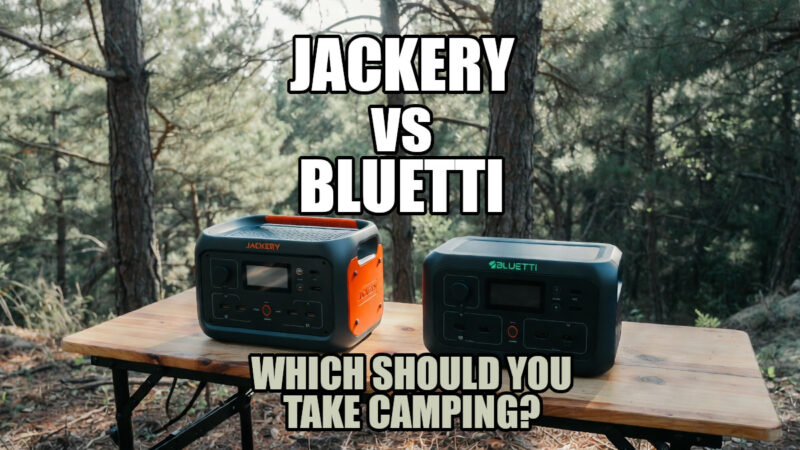
You’ve done the research. You’ve landed on two brands. Now you just want someone to stop hedging and tell you which one to buy.
Fair enough. Let’s do that.
The honest disclaimer first: both Jackery and Bluetti make genuinely good portable power stations. If you buy either one, you’ll probably be happy. This post exists because “probably happy” isn’t the same as “right call for your specific situation” — and the differences between these two brands are real enough to matter depending on how you camp.
Here’s where each one actually wins.
What Each Brand Is Really About
Jackery built its name on being the easiest power station in the room. The interface is clean, the display is intuitive, the orange color-coded cables are hard to lose, and you can hand one to someone who’s never touched a power station and they’ll have it figured out before you finish your coffee. That accessibility has a cost — Jackery tends to price slightly higher than Bluetti for comparable specs. But the user experience is genuinely polished in a way that matters if gear intimidation is a real thing in your camping group.
Bluetti competes on specs and value. At most capacity tiers, Bluetti gives you more watt-hours per dollar, longer-rated battery cycles on their newer units, and higher solar input ceilings. The tradeoff is a product lineup that takes more navigation to understand — names like AC2A, AC50B, AC70, AC180, Elite 100 V2 don’t exactly tell you where you are in the hierarchy the way “Explorer 1000” does. Once you know the lineup it’s fine. Getting there takes more homework.
Head-to-Head: What Actually Matters for Camping
Ease of Use
Jackery wins, and it’s not close. The display is more informative at a glance, port labeling is clearer, and the overall experience requires less reading of instructions. If you’re setting up camp at dusk after a long drive and just want to plug things in without thinking about it, Jackery is the more forgiving choice.
Capacity Per Dollar
Bluetti wins at most tiers. The clearest example is the 500-800Wh range: the Bluetti AC70 gives you 768Wh for around $599, while the comparable Jackery Explorer 600 v2 delivers 640Wh in the same price neighborhood. That’s a meaningful gap. Bluetti also frequently runs sales that bring their units down significantly from list price, which widens the value gap further.
Battery Longevity
Edge to Bluetti on their Elite series. The Elite 100 V2 and Elite 200 V2 use automotive-grade LFP cells rated for 6,000+ cycles. Jackery’s current LiFePO4 units run 4,000-6,000 cycles depending on the model — the Explorer 600 v2 is actually rated for 6,000 cycles, matching Bluetti’s top tier. At a practical level, a camper using their power station 50 times a year would need to camp for decades before either rating became relevant. But if you’re a heavy user running the unit frequently and want the longest possible lifespan, Bluetti’s Elite line holds the paper edge.
Charging Speed
Closer than it used to be. The Bluetti AC180 charges to 80% in 45 minutes. The Jackery Explorer 1000 v2 does it in about an hour. The AC70 hits 80% in 45 minutes as well. Neither brand is slow enough to be a genuine problem for camping use — you’re charging overnight or while you drive, not standing there watching a progress bar.
Solar Input
Bluetti wins by a meaningful margin at the mid-range tier. The AC70 accepts up to 500W of solar input. The Jackery Explorer 600 v2 accepts significantly less. If solar recharging is part of how you camp — particularly for multi-day trips where you’re trying to extend your run without driving back to an outlet — Bluetti’s solar input ceiling gives you more options with fewer panels.
Cold Weather Performance
Both brands use LiFePO4 on their current lineups, which handles cold significantly better than older Li-ion units. For PNW shoulder-season camping — cold mornings, damp conditions, sub-40°F nights — either brand’s current lineup will serve you better than anything with Li-ion chemistry. If you’re genuinely winter camping in the Cascades with overnight lows in the teens, Bluetti’s automotive-grade cells on the Elite series have an edge, but you’re deep into edge-case territory at that point.
Product Line Clarity
Jackery wins clearly. Explorer 300, 500, 600, 1000, 2000 — the numbers roughly track to capacity and make it easy to understand where you are in the lineup at a glance. Bluetti’s naming convention (AC2A, AC50B, AC70, AC180, Elite 30 V2, Elite 100 V2, Elite 200 V2) requires a decoder ring until you’ve spent time with it. Not a dealbreaker, but it does mean more research time before you’re confident in a purchase.
Warranty and Support
Comparable. Both offer 5-year warranties on current models. Jackery has a longer established US market presence and a deeper pool of reviews to draw from. Bluetti’s US support has improved significantly. Either brand will take care of you if something goes wrong — Jackery just has a longer track record of doing so.
Model-by-Model Matchups
Rather than rehash full specs here, here’s the short version at each tier. For the full breakdown, see our Best Portable Power Stations for Camping guide.
AC2A ($139) vs Explorer 300 Plus ($199) Bluetti is cheaper and lighter at 7.9 lbs. Jackery has more capacity at 288Wh vs 204Wh and a longer cycle rating at 4,000+ vs 3,000+. If budget is the priority and you just need phones and lights for a weekend, AC2A. If you want more headroom and better battery longevity, Explorer 300 Plus.
AC50B ($399) vs Explorer 500 ($329) Bluetti has LiFePO4 chemistry and 3,500+ cycles. Jackery’s Explorer 500 uses Li-ion with 800 cycles — a real difference for frequent users. Bluetti wins on longevity. Jackery wins on price and weight at 13.3 lbs vs 14.8 lbs. Check AC50B availability before committing — it runs in and out of stock.
AC70 ($599) vs Explorer 600 v2 Bluetti wins on capacity (768Wh vs 640Wh) and solar input (500W vs significantly less). Jackery wins on weight (14.11 lbs vs 22.5 lbs) and matches Bluetti on cycle rating at this tier (6,000+ cycles each). If you’re running solar seriously, AC70. If weight matters more than maximum capacity, Explorer 600 v2. Note the AC70 also runs in and out of stock.
AC180 / Elite 100 V2 vs Explorer 1000 v2 ($429) Three-way matchup. Explorer 1000 v2 wins on price and ease of use. Elite 100 V2 wins on compactness and battery longevity. AC180 wins on raw capacity and solar input at 500W. All three are genuinely excellent — the right call depends entirely on which of those three factors matters most to you.
Elite 200 V2 ($899) vs Explorer 2000 v2 ($699) Jackery is cheaper by $200. Bluetti has a higher cycle rating (6,000+ vs 4,000+) and more output headroom at 2,600W continuous. For a casual camper, Jackery’s price advantage is real. For a heavy or frequent user who wants the best long-term value per cycle, Bluetti justifies the premium.
Who Should Buy Jackery
You’re a first-time power station buyer and want zero learning curve. You’re handing a unit to someone in your camping group who isn’t a gear person. You prioritize weight over maximum capacity. You want the deepest pool of user reviews and community support to draw from. You’re buying in the 1,000Wh range where Jackery’s price advantage is strongest.
Who Should Buy Bluetti
You want maximum capacity per dollar at most tiers. Solar recharging is a real part of your camping strategy and you need the higher input ceiling. You’re a frequent or heavy user who wants the longest-rated battery lifespan. You’re comfortable doing a bit more research to navigate the product lineup. You’re watching for sales, because Bluetti discounts aggressively and the value gets even stronger.
The Honest Answer for Most Campers
If you’re a weekend car camper running phones, lights, and a small fridge — and you’re not doing serious solar charging and you’re not running the unit hard every single weekend — the difference between these two brands will not meaningfully affect your camping experience. Buy whichever one is on sale. Neither will disappoint you.
The decision actually matters if you fit one of these profiles:
You’re new to portable power and intimidated by gear → Jackery.
You’re running solar seriously or want the best capacity per dollar → Bluetti.
You’re a heavy user and battery longevity over years of use matters to you → Bluetti Elite series.
You want the most established brand with the deepest support network → Jackery.
That’s it. Pick your profile, buy the unit, go camping.
For the full model-by-model breakdown with specs and pricing at every capacity tier, head to our Best Portable Power Stations for Camping guide.
Got a specific setup question — rig type, trip length, devices you’re running — drop it in the comments or email cliff@10toestravel.com. I’ll give you a straight answer.
Disclosure: This post contains affiliate links to Jackery, Bluetti, and Amazon. If you purchase through those links I earn a small commission at no cost to you. I only recommend gear with a strong real-world track record. The opinions here are my own.